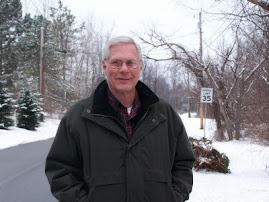
I met a man and his wife tonight. They were sitting on benches in front of our church as I mowed a section of the two acre churchyard. They were enjoying the cool evening in a lovely setting. After I finished I stopped to talk with them.
They were an elderly couple who lived in Bombay, India, but were visiting their daughter and her family here in upstate New York. The wife was here to consult with pain specialists who had recommended a non-surgical approach to the chronic leg pain she suffered. They had lived in New Jersey for some years before moving back to India.
The lovely lady, in her sixties, said she was lonely for company. "Where I live," she said, "you walk out of your house and people are everywhere. But not here." The gentleman chimed in, "But there are far too many people in India, and so much corruption, and not too many opportunities for work." He loved he opportunity to walk out of his daughter's home and enjoy a relatively benign setting with beauty and quiet.
I read recently that China has 1.3 billion people, and I know India has at least a billion. Populations in the third world are booming despite chaos and poor living conditions. In the United States, birth rates in the immigrant and lower classes are still high. Forecasts show a dramatic increase in world population by 2050. This must not happen.
Some futurists believe humans will solve their population problem by creating the engine of their own demise. Global warming, bird flu, and nuclear war all have the potential to reduce our population dramatically, and other major killers probably lurk outside our imagination. Any of these would be a poor way to solve the population problem. We can do better.
First world countries are currently growing their populations at the lowest rate. Educated people marry later and have fewer children for a variety of good reasons. Second and third world countries have higher growth rates for a variety of reasons, such as children being the substitute for Social Security in many places. But the growth must be stopped.
At the risk of being accused of racism or "ethnism", I think it's time for world leaders to speak out about uncontrolled population growth in countries that do not have the resources to support their current populations. I feel badly about youngsters who grow up in pitiable circumstances, and I even support one of them in Uganda, but I'm ambivalent about the efforts to provide relief, medical care, and food to groups who simply view their improved circumstances as an opportunity to grow their families. Birth control should be part of the deal.
The lady from Bombay missed her many friends, but her husband was dismayed over the teeming population in his city and the disfunctionality that it caused. For the sake of the human race, we need to find the right balance and find it before nature does it for us.
Saturday, June 21, 2008


Wednesday, June 18, 2008
Obama's Tax Plan
Some news came out today about Obama's tax plan. It's a populist approach that should knock the socks off the republican's "He'll raise your taxes" argument. Obama basically said that if you make less than $250,000, you don't have anything to worry about. That idea is going to appeal to many folks that like him but worry about their wallets and are tempted to stay with the republicans. It's going to upset those who are high earners, but that doesn't bother me at all. I'll tell you why.
The first reason is that for the past 30 years, income tax progressivity has been eroded significantly. The income tax rates paid by high earners have come down, the capital gains tax rates have come down, and the estate tax rates have come down. At the same time, rates for the middle class have not come down at anywhere near the scale experienced by the high earners. The underclass, which never paid much in taxes, has benefitted from credits (refunds of tax not paid), but this new income has not done much in terms of offsetting the higher cost of living for them. While it's true that a large percentage of the total tax is paid by high earners, they still have a lot more left over for themselves than they once had. They can clearly "afford" to pay more.
The second reason is that many of these high earners have benefitted from the huge increase in executive salaries compared to salaries in general. A professor in my MBA school once said, "Don't ever forget that, these days, the main purpose of the corporation is to benefit senior management." As a financial executive in a major corporation I witnessed rampant profiteering by the top people. In my view, they are simply employees like any others and often do not earn the huge salaries and bonuses they collect. They are not "owners" with their own skin in the game. If they had to pay 45-50% of all earned income over a very high number (say $1 million), it would not bother me at all. They'll still have plenty left over.
You'll hear arguments that high tax rates on the wealthy will harm our economy by reducing investment. Baloney! Investments follow risk-adjusted rates of return, and there is plenty of money in corporations and in other countries. The reduced-investment argument violates the principles of economics. Secondly, the economies of many European countries and Japan do very well dispite lower executive salaries and higher tax rates, which shows the fallacy of this argument.
In closing, I want to reiterate my position on the major redistribution of wealth that has taken place in the U.S. over the past 30 years. Reductions in income and estate taxation on the wealthy have created a large new class of super-rich that resemble the aristocracy of old time Europe. People like Warren Buffet have warned that this is a major problem. We don't need a class of people who are permanently wealthy regardless of their ability or contribution to society. Obama's tax plan is one way to put the brakes on this dangerous trend. Go, Obama!
The first reason is that for the past 30 years, income tax progressivity has been eroded significantly. The income tax rates paid by high earners have come down, the capital gains tax rates have come down, and the estate tax rates have come down. At the same time, rates for the middle class have not come down at anywhere near the scale experienced by the high earners. The underclass, which never paid much in taxes, has benefitted from credits (refunds of tax not paid), but this new income has not done much in terms of offsetting the higher cost of living for them. While it's true that a large percentage of the total tax is paid by high earners, they still have a lot more left over for themselves than they once had. They can clearly "afford" to pay more.
The second reason is that many of these high earners have benefitted from the huge increase in executive salaries compared to salaries in general. A professor in my MBA school once said, "Don't ever forget that, these days, the main purpose of the corporation is to benefit senior management." As a financial executive in a major corporation I witnessed rampant profiteering by the top people. In my view, they are simply employees like any others and often do not earn the huge salaries and bonuses they collect. They are not "owners" with their own skin in the game. If they had to pay 45-50% of all earned income over a very high number (say $1 million), it would not bother me at all. They'll still have plenty left over.
You'll hear arguments that high tax rates on the wealthy will harm our economy by reducing investment. Baloney! Investments follow risk-adjusted rates of return, and there is plenty of money in corporations and in other countries. The reduced-investment argument violates the principles of economics. Secondly, the economies of many European countries and Japan do very well dispite lower executive salaries and higher tax rates, which shows the fallacy of this argument.
In closing, I want to reiterate my position on the major redistribution of wealth that has taken place in the U.S. over the past 30 years. Reductions in income and estate taxation on the wealthy have created a large new class of super-rich that resemble the aristocracy of old time Europe. People like Warren Buffet have warned that this is a major problem. We don't need a class of people who are permanently wealthy regardless of their ability or contribution to society. Obama's tax plan is one way to put the brakes on this dangerous trend. Go, Obama!
Friday, June 13, 2008
"Your Ever Well-Wisher"
That would be ThomasLB, of course! He even made you feel good by reading his by-line. One of the joys of my internet life has been to stay in contact with Thomas, the bearded one who retreated from corporate life to living at home and doing who knows what.
We are so different, yet so similar. It's strange how the outward details of one's life mask the inner truth. We treasured so many of the same things, but he showed a sense of humor that I covet. I'd probably lecture him about sharing his great talents with the world, but he'd probably lecture me about not spending enough time smelling the roses.
I'm astonished when someone like Thomas decides to disappear. It's something like having a friend who takes their own life. "Why?", you ask. Who knows? Thomas can afford a new or used computer, but it's his own time that he's decided to conserve. He's walked away...
I admit to being a little angry. I miss ThomasLB. But, I also admit that each person has to walk their own path, and Thomas so much more than most. All the best, Mr. "Your Ever Well-Wisher".
We are so different, yet so similar. It's strange how the outward details of one's life mask the inner truth. We treasured so many of the same things, but he showed a sense of humor that I covet. I'd probably lecture him about sharing his great talents with the world, but he'd probably lecture me about not spending enough time smelling the roses.
I'm astonished when someone like Thomas decides to disappear. It's something like having a friend who takes their own life. "Why?", you ask. Who knows? Thomas can afford a new or used computer, but it's his own time that he's decided to conserve. He's walked away...
I admit to being a little angry. I miss ThomasLB. But, I also admit that each person has to walk their own path, and Thomas so much more than most. All the best, Mr. "Your Ever Well-Wisher".
Sunday, June 08, 2008
Gas at $4.00 and Rising!
Who would have thunk it? Oil at $138 per barrel and gasoline at $4.00 per gallon and rising fast. Apparently our government and our automobile and energy industries had no idea such a thing could happen, since none of them planned for it. Too bad for those of us who don't have so much money that we can be indifferent to the price of anything.
Don't think for one minute that our government and our automobile and energy industries should get a free pass on this. They are all responsible for the pain we are feeling, because they have acted in concert for many years to ensure the U.S. had a huge appetite for energy and did little to encourage conservation or find alternative energy sources. We should be outraged.
The fact is that other countries in our world have been much more prepared for the very predictable tightening of energy supplies. Europe and Japan lead in producing fuel-efficient vehicles, using nuclear power and alternative energy sources, and in conservation. They adjusted to the obvious, but we did not. We wallowed in cheap energy for many years, and now we are going to burn in the fire of very expensive energy until we can get our act together. "Smart" America has been really stupid when it comes to energy.
It is going to be really expensive to fix our energy-related problems. Our homes and cars are too big and inefficient. Our laws favor the industries that have failed to act on our behalf. Developing and installing the new technologies needed to save us will take a long time, during which we will suffer financially and in our standard of living. All of this is due largely to poor planning by those we have trusted to act on our behalf.
Will we learn from this sad experience? Will we ask our government to anticipate problems and give us strong advice about what we need to do, even if it is painful? The next year or two will be telling in that respect, because we have other big problems to solve. The war, Medicare, Social Security, education. Each of these can impact us as hard as gas prices do now. Will the next president and congress take these on or bury their heads in the sand, waiting for a crisis and not doing anything until it's too late? We'll see.
Don't think for one minute that our government and our automobile and energy industries should get a free pass on this. They are all responsible for the pain we are feeling, because they have acted in concert for many years to ensure the U.S. had a huge appetite for energy and did little to encourage conservation or find alternative energy sources. We should be outraged.
The fact is that other countries in our world have been much more prepared for the very predictable tightening of energy supplies. Europe and Japan lead in producing fuel-efficient vehicles, using nuclear power and alternative energy sources, and in conservation. They adjusted to the obvious, but we did not. We wallowed in cheap energy for many years, and now we are going to burn in the fire of very expensive energy until we can get our act together. "Smart" America has been really stupid when it comes to energy.
It is going to be really expensive to fix our energy-related problems. Our homes and cars are too big and inefficient. Our laws favor the industries that have failed to act on our behalf. Developing and installing the new technologies needed to save us will take a long time, during which we will suffer financially and in our standard of living. All of this is due largely to poor planning by those we have trusted to act on our behalf.
Will we learn from this sad experience? Will we ask our government to anticipate problems and give us strong advice about what we need to do, even if it is painful? The next year or two will be telling in that respect, because we have other big problems to solve. The war, Medicare, Social Security, education. Each of these can impact us as hard as gas prices do now. Will the next president and congress take these on or bury their heads in the sand, waiting for a crisis and not doing anything until it's too late? We'll see.
Friday, June 06, 2008
"Conservatives" Always Lose - In the Long Run
If you pay attention to the media, you know that there are many newspapers, radio stations, and TV networks that identify themselves as "conservative" either overtly or by their content. They tend to kowtow toward the predominant religion, glorify patriotism (which they define as their own views on the current government), and stand for an economic policy which ensures that the current "haves" grow their fortunes. In short, conservatives like the world to stay pretty much like it is (when they are in power), or like it was (before they lost power). They abhor change, whether it be in religion, social mores, politics, science or economics. But they always lose, in the long run, because change happens.
As we move a bit further into the 21st century, we see change on every front. Genetic engineering, powerful new telescopes, nanotechnology, and climate change are providing new scientific information that must be acted upon. The world's political power structure is evolving eastward with a velocity that would have been scoffed at only 25 years ago. Many churches are reaching out to homosexuals and starting to focus more directly on religious "action" rather than dogmatic theology. The world's appetite for fossil fuels is driving up their prices and motivating accelerated research into new energy sources. Women are holding key positions in government and industry. The world is re-making itself, and conservatives are in a tizzy because they are not change-oriented.
We often mistakenly see conservatives as people with right wing capitalist leanings, but conservatives are simply those who dislike change. The communist USSR was as conservative a regime as there has ever been, simply because it singlemindedly pursued a political/economic model that proved faulty and eventually collapsed the country. Conservative management and unions in the American auto industry resisted change and are now watching their markets and their employee base shrink dramatically. Conservative Roman Catholic bishops looked the other way at priestly pedophiles for centuries, but their adherence to the old rules has cost their church much treasure and eroded its moral standing. These examples show that change can be successfully resisted for a time, but that time often ends with devastating consequences for those whose feet have been stuck in the status quo.
Conservatives have had a prominent or dominant position in U.S. politics for more than 20 years, and not long ago they looked forward to a century of such dominance. But they, like conservatives of all ages, refused to acknowledge that the world was changing all around them - in science, religion, social mores, and economics. They made decisions based on obsolete facts and beliefs, and Americans have watched as these decisions produced adverse consequences. Americans now see us mired in an unnecessary and costly war, unprepared for high fuel prices, pummelled by climate-change-induced storms, and ruled by layers of incompetents. The tide is turning, and the November election will turn out self-described conservatives in droves.
Does this mean that the liberals will lead us forever? No. They have their own constituencies, and these constituencies also resist change. Take the teacher's unions, for example. They talk liberal from a social perspective, but they are conservative as hell when it comes to economics or change in the education process. The best we can hope for, then, is that the liberal administration will attack and solve some of the obvious problems before they, too, get stuck by moving their focus toward consolidating their gains and hanging on to power. The conservatives will then return to restore order for a time.
It turns out that we need both liberals and conservatives to move the world along. But the liberals always win in the long run. Change is inexorable. It's time for change.
As we move a bit further into the 21st century, we see change on every front. Genetic engineering, powerful new telescopes, nanotechnology, and climate change are providing new scientific information that must be acted upon. The world's political power structure is evolving eastward with a velocity that would have been scoffed at only 25 years ago. Many churches are reaching out to homosexuals and starting to focus more directly on religious "action" rather than dogmatic theology. The world's appetite for fossil fuels is driving up their prices and motivating accelerated research into new energy sources. Women are holding key positions in government and industry. The world is re-making itself, and conservatives are in a tizzy because they are not change-oriented.
We often mistakenly see conservatives as people with right wing capitalist leanings, but conservatives are simply those who dislike change. The communist USSR was as conservative a regime as there has ever been, simply because it singlemindedly pursued a political/economic model that proved faulty and eventually collapsed the country. Conservative management and unions in the American auto industry resisted change and are now watching their markets and their employee base shrink dramatically. Conservative Roman Catholic bishops looked the other way at priestly pedophiles for centuries, but their adherence to the old rules has cost their church much treasure and eroded its moral standing. These examples show that change can be successfully resisted for a time, but that time often ends with devastating consequences for those whose feet have been stuck in the status quo.
Conservatives have had a prominent or dominant position in U.S. politics for more than 20 years, and not long ago they looked forward to a century of such dominance. But they, like conservatives of all ages, refused to acknowledge that the world was changing all around them - in science, religion, social mores, and economics. They made decisions based on obsolete facts and beliefs, and Americans have watched as these decisions produced adverse consequences. Americans now see us mired in an unnecessary and costly war, unprepared for high fuel prices, pummelled by climate-change-induced storms, and ruled by layers of incompetents. The tide is turning, and the November election will turn out self-described conservatives in droves.
Does this mean that the liberals will lead us forever? No. They have their own constituencies, and these constituencies also resist change. Take the teacher's unions, for example. They talk liberal from a social perspective, but they are conservative as hell when it comes to economics or change in the education process. The best we can hope for, then, is that the liberal administration will attack and solve some of the obvious problems before they, too, get stuck by moving their focus toward consolidating their gains and hanging on to power. The conservatives will then return to restore order for a time.
It turns out that we need both liberals and conservatives to move the world along. But the liberals always win in the long run. Change is inexorable. It's time for change.
Wednesday, June 04, 2008
Golf Update
Did you know that walking 18 holes of golf at a reasonable pace is really good exercise, especially if you do it fairly regularly? Golf is also good for training your body to obey, since the golf ball goes in strange directions if your body can't follow your bidding when you swing. And, golf is great for developing concentration because you need to focus only on the task at hand (the stroke you are making) to avoid considerable embarassment and move the ball to its intended position. These are all the reasons I provide the Good Witch for my frequent disappearances from her life. She knows it's not another woman if the course is open.
Golf season in Rochester, NY, starts in mid-April for the most hardy souls, and by mid-May for most others. The warmer days, cool nights, and decent rainfall makes the grass grow green, thick, and beautiful. By early June the courses are lovely and difficult, and us players are starting to get our games tuned up. My game is on schedule, and I'm a happy guy.
Golf is the best game for men. It challenges our physical skill, provides a group environment for socializing, and takes four hours away from the routine of work. In my experience, only the army or other sports teams can compare with the benefits men get from playing golf with buddies on a regular basis. Women seem to enjoy it as well, but maybe for slightly different reasons.
So, where am I now? Lots of my drives are going 240-260 yards, with over 50% in the fairway. I'm able to hit greens about half the time in regulation. My short game of pitch shots, sand shots, and chips is getting pretty comfortable and productive. My putts are pretty decent, and I'm making a lot of six footer's. That means that I'm able to post a score of about 84-88 most days. The scores are usually hurt by a couple of poorly played holes, but I'm starting to minimize the big mistakes. That means that shooting 80 in June is likely. Hooray!
Next month I'll be 64. There's a good chance that this year will be my best ever for golf - I'll play the game more skillfully than I did when I was much younger and stronger. In what other sport could a man say that?
Golf season in Rochester, NY, starts in mid-April for the most hardy souls, and by mid-May for most others. The warmer days, cool nights, and decent rainfall makes the grass grow green, thick, and beautiful. By early June the courses are lovely and difficult, and us players are starting to get our games tuned up. My game is on schedule, and I'm a happy guy.
Golf is the best game for men. It challenges our physical skill, provides a group environment for socializing, and takes four hours away from the routine of work. In my experience, only the army or other sports teams can compare with the benefits men get from playing golf with buddies on a regular basis. Women seem to enjoy it as well, but maybe for slightly different reasons.
So, where am I now? Lots of my drives are going 240-260 yards, with over 50% in the fairway. I'm able to hit greens about half the time in regulation. My short game of pitch shots, sand shots, and chips is getting pretty comfortable and productive. My putts are pretty decent, and I'm making a lot of six footer's. That means that I'm able to post a score of about 84-88 most days. The scores are usually hurt by a couple of poorly played holes, but I'm starting to minimize the big mistakes. That means that shooting 80 in June is likely. Hooray!
Next month I'll be 64. There's a good chance that this year will be my best ever for golf - I'll play the game more skillfully than I did when I was much younger and stronger. In what other sport could a man say that?
Saturday, May 31, 2008
Fixing America, Maybe
I was happy to hear that the democratic party has settled its self-inflicted wound regarding the Florida and Michigan primaries, and that this will make Obama their presumptive nominee. He has run a clean and respectable campaign, and this bodes well for what he might do as president.
With all due respect to Hillary Clinton, we don't need any more royal families in America. She may be qualified to be president, but she has too much personal baggage and she owes too many favors to too many people. And, I really hate to mention it but I don't savor the thought of Bill Clinton being back in the White House where his personal conduct disgraced him and poisoned his administration.
Hopefully, the race for president is now mostly over. I've watched and listened to John McCain, and he's a loser. He is a man of another age, not the 21st century. He's consumed with the military and the threat of terrorism, not with making America internally strong again. He's flip-flopped on several major issues in order to court the right wing of the republican party, and these flip-flops will be highlighted by Obama's campaign. Does he really believe in anything? And, McCain is just too old. As a robust almost 64-year-old, more robust than McCain, I can tell you that I don't have the energy to be president. The oval office is not for afternoon naps! Obama should win in November.
My hope is that Obama will act deliberately to address the systemic issues that afflict America today. We don't need inflammatory rhetoric like "the war on terror". We need rational discourse, fact-based deliberations, and legislation and regulation that will slowly bring us to a new place. That will require Obama to marginalize both the wacko right and the wacko left. Can we get out of Iraq smoothly? Can we fund the entitlements without going bankrupt? Can we make major progress on energy independence? Can we fix education? Obama will need a really smart team to solve these problems, and I hope he is smart enough to recruit them.
The future is always uncertain, and things often go in unanticipated directions. But we can only do what we truly believe is the "right thing" at each moment, and then go from there. Tonight I think Obama is on the right track, and I've sent him some cash. Here's hoping it turns out to be a good investment!
With all due respect to Hillary Clinton, we don't need any more royal families in America. She may be qualified to be president, but she has too much personal baggage and she owes too many favors to too many people. And, I really hate to mention it but I don't savor the thought of Bill Clinton being back in the White House where his personal conduct disgraced him and poisoned his administration.
Hopefully, the race for president is now mostly over. I've watched and listened to John McCain, and he's a loser. He is a man of another age, not the 21st century. He's consumed with the military and the threat of terrorism, not with making America internally strong again. He's flip-flopped on several major issues in order to court the right wing of the republican party, and these flip-flops will be highlighted by Obama's campaign. Does he really believe in anything? And, McCain is just too old. As a robust almost 64-year-old, more robust than McCain, I can tell you that I don't have the energy to be president. The oval office is not for afternoon naps! Obama should win in November.
My hope is that Obama will act deliberately to address the systemic issues that afflict America today. We don't need inflammatory rhetoric like "the war on terror". We need rational discourse, fact-based deliberations, and legislation and regulation that will slowly bring us to a new place. That will require Obama to marginalize both the wacko right and the wacko left. Can we get out of Iraq smoothly? Can we fund the entitlements without going bankrupt? Can we make major progress on energy independence? Can we fix education? Obama will need a really smart team to solve these problems, and I hope he is smart enough to recruit them.
The future is always uncertain, and things often go in unanticipated directions. But we can only do what we truly believe is the "right thing" at each moment, and then go from there. Tonight I think Obama is on the right track, and I've sent him some cash. Here's hoping it turns out to be a good investment!
Tuesday, May 27, 2008
The Ambulance Business is Changing
As you may know, I'm a fairly busy EMT. I'm also currently the president of a volunteer ambulance corps that has about 100 members and gets about six calls every day. I've been a medic since 1999 and covered about 2,000 calls since then. It's mostly routine for us, but I and my partner often make a stressful situation much more bearable for the people we serve . In recent years, however, the ambulance business has changed a lot and not always for the better.
The first change was the gradual increase in the number of calls coded for paramedic support. Paramedics are highly trained emergency medical providers, and they get paid. What they do is called "advanced life support", which includes cardiac monitoring, invasive breathing support, and administration of powerful drugs ususally via IV. They can also do heart pacing and other cool things. The thing is, their specialized skills are required only in potentially life threatening situations. The great majority of patients simply need a ride to the hospital, or some oxygen, or to have their broken bone stabilized prior to being transported. But paramedics are being dispatched on many more calls than previously, partly because there are more of them and partly as "defensive medicine". EMT's are going the way of the dinosaurs, since they run fewer and fewer calls on their own and often stand by while a paramedic performs unnecessary procedures on a patient.
You may say, "This is great!". You get a more qualified person to help you when you're sick or hurt. That part is true. The other side of the coin, however, is that you get a much bigger bill for ambulance services. The company that employs the paramedic is going to charge you (or your insurance) about $400-$500 for 15-20 minutes of monitoring you on the way to the hospital, whether you really need it or not. EMT's, on the other hand, are pretty well trained to evaluate symptoms and determine whether or not a paramedic is needed. We are much less expensive, or even free of charge, like me. But we are being pushed out in favor of much more costly professionals. I may ultimately stop doing this work because cases I used to handle without incident are now being coded for paramedic involvement. The patients are seldom any better off, but they pay a lot more and I get bored.
The second issue involves reporting requirements. When I started we had one version of a written report. A few years later we got a new report form, much improved in my opinion, with lots of check boxes for what we found and what we did for the patient. Recently we have gone to computer input of our reporting - we have laptops on the ambulances and we can access the software from any internet computer. Completing this computer-based reporting (about 8 screens worth) takes at least 30 minutes per call - after the call. We once were able to come back to the base, write one or two more things on our mostly completed paper-based reporting, and be done. Now we need 30 minutes to finish the call on the computer. If we get three calls in quick succession, we get to do 1.5 hours of keypunching when we finally get home to the base. That stinks! Worse yet, it's hard to see whether this adds anything of value to what we've already done. Why should a volunteer have to put up with this?
This tirade is aimed at those who think that more is always better. It's not. Life is all about trade-off's. "More" costs more. "Is it worth it" is seldom asked. In my view the cost of living in America is going up in many cases simply because that simple question is not being asked or answered. There is little doubt that many more paramedic jobs, paying from $15-25 per hour, often with benefits, are being created. Also, electronic reporting provides a great mass of data about ambulance calls. But are these things really improvements? In my view, we pay a hidden tax by being provided with more qualified care than is necessary or requiring ambulance personnel to spend more time preparing a report than they just spent taking care of a patient.
Am I the only one who feels this way? No. My own physician complained bitterly about his own computer-based reporting when I last visited him, and I know he's not allowed to do simple procedures that my family doctor routinely performed 50 years ago. The medical profession is being overwhelmed at all levels by the bureaucracy and defensive medicine.
If we are ever going to have an excellent and efficient national health care system, those who implement it will have a lot of choices about where the money gets spent. If they opt for defensive medicine at every level, which seems to be the trend, health care will bankrupt our country. Think of an agency like the boneheaded Homeland Security agency for health care - bureaucracy in triplicate and job #1 for everyone is to cover their "behind". Sanity is needed, but government seldom has it. So, a fine volunteer agency like mine has experienced people with great records pissed off and ready to quit because government is getting overly cautious and intrusive. Is this the America of self-reliance and freedom, or is this the coming America of the bureaucrats?
The first change was the gradual increase in the number of calls coded for paramedic support. Paramedics are highly trained emergency medical providers, and they get paid. What they do is called "advanced life support", which includes cardiac monitoring, invasive breathing support, and administration of powerful drugs ususally via IV. They can also do heart pacing and other cool things. The thing is, their specialized skills are required only in potentially life threatening situations. The great majority of patients simply need a ride to the hospital, or some oxygen, or to have their broken bone stabilized prior to being transported. But paramedics are being dispatched on many more calls than previously, partly because there are more of them and partly as "defensive medicine". EMT's are going the way of the dinosaurs, since they run fewer and fewer calls on their own and often stand by while a paramedic performs unnecessary procedures on a patient.
You may say, "This is great!". You get a more qualified person to help you when you're sick or hurt. That part is true. The other side of the coin, however, is that you get a much bigger bill for ambulance services. The company that employs the paramedic is going to charge you (or your insurance) about $400-$500 for 15-20 minutes of monitoring you on the way to the hospital, whether you really need it or not. EMT's, on the other hand, are pretty well trained to evaluate symptoms and determine whether or not a paramedic is needed. We are much less expensive, or even free of charge, like me. But we are being pushed out in favor of much more costly professionals. I may ultimately stop doing this work because cases I used to handle without incident are now being coded for paramedic involvement. The patients are seldom any better off, but they pay a lot more and I get bored.
The second issue involves reporting requirements. When I started we had one version of a written report. A few years later we got a new report form, much improved in my opinion, with lots of check boxes for what we found and what we did for the patient. Recently we have gone to computer input of our reporting - we have laptops on the ambulances and we can access the software from any internet computer. Completing this computer-based reporting (about 8 screens worth) takes at least 30 minutes per call - after the call. We once were able to come back to the base, write one or two more things on our mostly completed paper-based reporting, and be done. Now we need 30 minutes to finish the call on the computer. If we get three calls in quick succession, we get to do 1.5 hours of keypunching when we finally get home to the base. That stinks! Worse yet, it's hard to see whether this adds anything of value to what we've already done. Why should a volunteer have to put up with this?
This tirade is aimed at those who think that more is always better. It's not. Life is all about trade-off's. "More" costs more. "Is it worth it" is seldom asked. In my view the cost of living in America is going up in many cases simply because that simple question is not being asked or answered. There is little doubt that many more paramedic jobs, paying from $15-25 per hour, often with benefits, are being created. Also, electronic reporting provides a great mass of data about ambulance calls. But are these things really improvements? In my view, we pay a hidden tax by being provided with more qualified care than is necessary or requiring ambulance personnel to spend more time preparing a report than they just spent taking care of a patient.
Am I the only one who feels this way? No. My own physician complained bitterly about his own computer-based reporting when I last visited him, and I know he's not allowed to do simple procedures that my family doctor routinely performed 50 years ago. The medical profession is being overwhelmed at all levels by the bureaucracy and defensive medicine.
If we are ever going to have an excellent and efficient national health care system, those who implement it will have a lot of choices about where the money gets spent. If they opt for defensive medicine at every level, which seems to be the trend, health care will bankrupt our country. Think of an agency like the boneheaded Homeland Security agency for health care - bureaucracy in triplicate and job #1 for everyone is to cover their "behind". Sanity is needed, but government seldom has it. So, a fine volunteer agency like mine has experienced people with great records pissed off and ready to quit because government is getting overly cautious and intrusive. Is this the America of self-reliance and freedom, or is this the coming America of the bureaucrats?
Thursday, May 22, 2008
Government Spending - A "Secret Place"
You know what really bugs me? It's the constant harping about the government not spending enough money on just about every service it provides. Armed forces pay, teacher pay, prescription drugs and medical procedures, farm subsidies, food inspections - you name it, somebody is bitching about how we don't spend enough money on it. Well, here's what I think. If we really knew what was spent on this stuff, we'd want to throw up. That's why we're never told in straight terms what the government pays.
Here's an example. In 2008, a junior officer (Army captain, for example) with six years experience (age, about 30) will get a base pay of $57,156 plus a free 0n-base home or an off-base housing allowance. He and his family will get free medical care, and he'll be able to retire at half pay after 20 years of service. Granted, he has an important job and some risk, but the great majority of officers at this rank will never see combat. It's a darn good job if you're willing to move around at the government's pleasure, sometimes to some pretty good places. You'd have never guessed it if I didn't tell you, and I can think of plenty of harder jobs that pay less.
Teacher pay. Teachers in my school district can make $90,000 and full medical coverage, plus retire at something like 2/3's of their final pay and full medical after 30 years. That's for teaching about 185 days each year. Competition for these jobs is unbelievable, and you can see why. Why is it, I wonder, that teacher pay is a big issue around here? It's because the average person has no facts.
Medicaid spending. It's the largest single component of my county's budget, by far, and it's growing like topsy and forcing property tax increases. I've never seen an analysis as simple as this: the per-person cost for each Medicaid recipient in this county, and the breakdown by doctor bills, prescriptions, and hospital costs. If we taxpayers saw these numbers, we would go crazy because they are so much higher than what we pay for our own care. But we're never told. Medicaid is an industry, and we provide the revenue for it.
Today the U.S. senate passed a $290 billion farm bill - $290 billion in farm subsidies, the lion's share going to larger agribusinesses. This at a time when farmers are experiencing a bonanza in crop prices and recond profits. It's an election year, you see, and congress wants those farm state votes. They're paying for them with your money.
And so it goes. "Big Government" is out of control. There is no accountability, and the only brake on spending is potential taxpayer revolt. The government takes what the market (you and me) will bear. The great size of government, and its multitude of functions, keep us from understanding it. And that's exactly how "Big Government" wants it to be.
OK, you say. That's the problem. What is the answer? Probably two things: first, information like what I've presented above. Put the big spending items into some perspective that the average person can understand. Second, more citizen input on spending, such as referendum and initiative. It's not surprising that New York is one of the top taxing states, does not have referendum and intiative, and that the special interests and the politicians won't even consider them.
You may think I'm some wild-eyed libertarian. I'm not. I think the government needs to handle many functions in our complex society. I just don't think the rest of us should be stuck with a much bigger bill than is necessary. Think about that when you cast your votes in the fall...there are candidates who are serious about managing the cost of government. Give them a chance to work for all of us, to uncover and eliminate the secrecy of government spending.
Here's an example. In 2008, a junior officer (Army captain, for example) with six years experience (age, about 30) will get a base pay of $57,156 plus a free 0n-base home or an off-base housing allowance. He and his family will get free medical care, and he'll be able to retire at half pay after 20 years of service. Granted, he has an important job and some risk, but the great majority of officers at this rank will never see combat. It's a darn good job if you're willing to move around at the government's pleasure, sometimes to some pretty good places. You'd have never guessed it if I didn't tell you, and I can think of plenty of harder jobs that pay less.
Teacher pay. Teachers in my school district can make $90,000 and full medical coverage, plus retire at something like 2/3's of their final pay and full medical after 30 years. That's for teaching about 185 days each year. Competition for these jobs is unbelievable, and you can see why. Why is it, I wonder, that teacher pay is a big issue around here? It's because the average person has no facts.
Medicaid spending. It's the largest single component of my county's budget, by far, and it's growing like topsy and forcing property tax increases. I've never seen an analysis as simple as this: the per-person cost for each Medicaid recipient in this county, and the breakdown by doctor bills, prescriptions, and hospital costs. If we taxpayers saw these numbers, we would go crazy because they are so much higher than what we pay for our own care. But we're never told. Medicaid is an industry, and we provide the revenue for it.
Today the U.S. senate passed a $290 billion farm bill - $290 billion in farm subsidies, the lion's share going to larger agribusinesses. This at a time when farmers are experiencing a bonanza in crop prices and recond profits. It's an election year, you see, and congress wants those farm state votes. They're paying for them with your money.
And so it goes. "Big Government" is out of control. There is no accountability, and the only brake on spending is potential taxpayer revolt. The government takes what the market (you and me) will bear. The great size of government, and its multitude of functions, keep us from understanding it. And that's exactly how "Big Government" wants it to be.
OK, you say. That's the problem. What is the answer? Probably two things: first, information like what I've presented above. Put the big spending items into some perspective that the average person can understand. Second, more citizen input on spending, such as referendum and initiative. It's not surprising that New York is one of the top taxing states, does not have referendum and intiative, and that the special interests and the politicians won't even consider them.
You may think I'm some wild-eyed libertarian. I'm not. I think the government needs to handle many functions in our complex society. I just don't think the rest of us should be stuck with a much bigger bill than is necessary. Think about that when you cast your votes in the fall...there are candidates who are serious about managing the cost of government. Give them a chance to work for all of us, to uncover and eliminate the secrecy of government spending.
Sunday, May 18, 2008
Islamic Doublethink?
I'm no Islamophobe. I've got Muslim friends and friends who adhere to other religions, or no religion, as well. I believe God speaks to people in many ways. However, I'm confused about why Islam is so paranoid about "images" of animals or people, thinking that they may arouse idolatry, and so protective of the Quran itself. It seems to me that perhaps one can so revere two pieces of cardboard with paper inside that reverence for God might take second place to this physical thing as well.
I'm a Christian, so the Bible is important to me. In my view, it is the most important source of God's word to man. Yet I'm not at all protective of the Bible itself. If someone wants to step on it, burn it, or deface or ruin it in any way, I'm not going to take offense. Rather, I'm likely to feel sorry for the person and try to find out what would make a person want to do that. In my view, God alone can judge, or perhaps punish that person for their intent. For my part, the Bible is cardboard and paper. Harming it does not do actual harm to God in any way, and God does not need me to help defend the Almighty. God is surely capable of self-defense against such puny creatures as we.
Today I read a story about an American soldier shooting up a Quran. A general ended up apologizing profusely, another officer produced a new Quran and kissed it before handing it over to some Islamic clerics, and the soldier was brought home in disgrace. I'd say the soldier was stupid and wrong to do what he did, and his act was disrespectful to Muslims, but I'd leave the idea of defending God out of the conversation about this incident. Allah can take care of Allah's interests, no doubt. The soldier's act was the latest in a series of such Quran desecrations where violent revenge was threatened or taken for the insult. It seems to me that the book itself has just as much potential for idolatry as a picture. It is a material thing, and it seems to me that it can become just as much an icon as any graven image or picture.
More broadly, I view this situation as another of the millions of situations where members of one faith "insult" members of another either verbally or by some sort of desecration. We have civil laws against the more flagrant of these situations - painting swastikas on temples, turning over gravestones, messing around with stuff on an altar, discriminating against someone of another religion, etc. At some point even repeatedly calling people names becomes harassment. These are the laws that should pertain to things like shooting a Quran or taking a Bible out of a church and tearing it up. But when those of the "offended" faith start talking about revenge (in the name of God), things have got way out of hand and often the retribution is out of proportion to the offense.
Perhaps I have a Muslim reader who can explain why this man-made thing that eventually will fall apart on its own is so important to defend with violence? I wouldn't misuse a Quran simply out of respect for this reader and his/her co-religionists, but I can't imagine why some Muslims hyperventilate when idiots do what idiots will do. Is a book really worth rioting and killing for? Just curious.
I'm a Christian, so the Bible is important to me. In my view, it is the most important source of God's word to man. Yet I'm not at all protective of the Bible itself. If someone wants to step on it, burn it, or deface or ruin it in any way, I'm not going to take offense. Rather, I'm likely to feel sorry for the person and try to find out what would make a person want to do that. In my view, God alone can judge, or perhaps punish that person for their intent. For my part, the Bible is cardboard and paper. Harming it does not do actual harm to God in any way, and God does not need me to help defend the Almighty. God is surely capable of self-defense against such puny creatures as we.
Today I read a story about an American soldier shooting up a Quran. A general ended up apologizing profusely, another officer produced a new Quran and kissed it before handing it over to some Islamic clerics, and the soldier was brought home in disgrace. I'd say the soldier was stupid and wrong to do what he did, and his act was disrespectful to Muslims, but I'd leave the idea of defending God out of the conversation about this incident. Allah can take care of Allah's interests, no doubt. The soldier's act was the latest in a series of such Quran desecrations where violent revenge was threatened or taken for the insult. It seems to me that the book itself has just as much potential for idolatry as a picture. It is a material thing, and it seems to me that it can become just as much an icon as any graven image or picture.
More broadly, I view this situation as another of the millions of situations where members of one faith "insult" members of another either verbally or by some sort of desecration. We have civil laws against the more flagrant of these situations - painting swastikas on temples, turning over gravestones, messing around with stuff on an altar, discriminating against someone of another religion, etc. At some point even repeatedly calling people names becomes harassment. These are the laws that should pertain to things like shooting a Quran or taking a Bible out of a church and tearing it up. But when those of the "offended" faith start talking about revenge (in the name of God), things have got way out of hand and often the retribution is out of proportion to the offense.
Perhaps I have a Muslim reader who can explain why this man-made thing that eventually will fall apart on its own is so important to defend with violence? I wouldn't misuse a Quran simply out of respect for this reader and his/her co-religionists, but I can't imagine why some Muslims hyperventilate when idiots do what idiots will do. Is a book really worth rioting and killing for? Just curious.
Friday, May 16, 2008
Optimistic About America
"Necessity is the mother of invention". Trite, but true. Often the only way to get action started is to create a crisis. Well, America has finally got a crisis on its hands with gas prices, and soon we will also realize that America's fiscal affairs also represent a crisis of major proportions. This is good, for we will finally, if belatedly, roll up our sleeves and do something about changing out our energy supplies and fixing our entitlement imbalances.
It's hard to be optimistic when a big chunk of previously disposable income is now exiting the exhaust pipe and the American dollar is under water, but I think we should be happy. Our country is blessed with millions of smart, creative people and a political/economic system that is flexible enough to undergo dramatic change without breaking. Our country will be a lot different in ten years, and the metamorphosis won't be too painful.
Not sure about this prognostication? Just remember what we did when we finally decided to stop Hitler. Our moribund industrial sector flipped its priorities and ramped up in an incredibly short time to produce everything we needed to win a worldwide war. And when the Russians beat us to space, we responded by standing on the moon within ten years using less computer power than my cell phone now has. America is just as capable now as then - we just seem to need a kick in the pants to get going.
I'm excited about the future. At almost 64, I have perhaps one more generation of time to view the evolution of America. All we need now is some leadership to get us on the same page and free us to get busy. Take heart! Our new world is just around the corner, and getting there will be fun.
It's hard to be optimistic when a big chunk of previously disposable income is now exiting the exhaust pipe and the American dollar is under water, but I think we should be happy. Our country is blessed with millions of smart, creative people and a political/economic system that is flexible enough to undergo dramatic change without breaking. Our country will be a lot different in ten years, and the metamorphosis won't be too painful.
Not sure about this prognostication? Just remember what we did when we finally decided to stop Hitler. Our moribund industrial sector flipped its priorities and ramped up in an incredibly short time to produce everything we needed to win a worldwide war. And when the Russians beat us to space, we responded by standing on the moon within ten years using less computer power than my cell phone now has. America is just as capable now as then - we just seem to need a kick in the pants to get going.
I'm excited about the future. At almost 64, I have perhaps one more generation of time to view the evolution of America. All we need now is some leadership to get us on the same page and free us to get busy. Take heart! Our new world is just around the corner, and getting there will be fun.
Wednesday, May 14, 2008
Hillary's Strength is America's Weakness
Recent polling statistics and election results have shown that Hillary Clinton's likely voters fall into three categories: whites without a college education, the elderly, and government/teacher union members. I can understand why she gets these votes, but America will not prosper if the new president is indebted to these groups for supporting her.
It's telling that educated democrats favor Obama over Clinton, but uneducated ones favor Clinton. Part of the answer is "race" consciousness, part of the answer is ignorance (or, to be more genteel about it, lack of information and critical thinking), and part of the answer is Clinton's outrageous pandering to what she calls "hard-working Americans". Except that they didn't work hard in school, nor do they have much in the way of marketable skills. Obama, on the other hand, gets support from Paul Volker and three past heads of the SEC. Whose opinion counts the most?
The elderly are, generally speaking, the segment of the population who are most race-conscious (after West Virginians and Arkansans (?), of course). These folks also are the largest constituency for the government entitlements that are bankrupting our country. Do we really want our next president elected by those who depend on government for their financial security - by our debtor class, so to speak? Government spending on the elderly needs to be controlled, not enhanced, and Obama speaks much more cogently on this issue.
I live in New York, a state that ranks at the top of highest-taxing states largely because it has a bloated population of unionized state employees and powerful teacher unions. Per capita of population, New York has twice as many state employees as California. It also has a huge debt that neither democrat nor republican administrations has been able to control. The fact is that public employee and teacher unions, who are powerful Clinton supporters, care a lot more about their overly generous retirement and health care plans than they do about the long term success of our state, just as GM employees cared more about their pay and benefits than about GM's continued competitiveness. Do we need a president who owes her success to these groups?
Obama is about change, which is going to mean tackling America's problems in a straightforward manner. He's been pretty clear about this in major speeches. Clinton is about change that benefits her constituencies and diminishes America because resources will be diverted to non-productive purposes. Will we buy into her populist demagoguery and her pandering to entrenched special interests in the party? I hope not.
It's telling that educated democrats favor Obama over Clinton, but uneducated ones favor Clinton. Part of the answer is "race" consciousness, part of the answer is ignorance (or, to be more genteel about it, lack of information and critical thinking), and part of the answer is Clinton's outrageous pandering to what she calls "hard-working Americans". Except that they didn't work hard in school, nor do they have much in the way of marketable skills. Obama, on the other hand, gets support from Paul Volker and three past heads of the SEC. Whose opinion counts the most?
The elderly are, generally speaking, the segment of the population who are most race-conscious (after West Virginians and Arkansans (?), of course). These folks also are the largest constituency for the government entitlements that are bankrupting our country. Do we really want our next president elected by those who depend on government for their financial security - by our debtor class, so to speak? Government spending on the elderly needs to be controlled, not enhanced, and Obama speaks much more cogently on this issue.
I live in New York, a state that ranks at the top of highest-taxing states largely because it has a bloated population of unionized state employees and powerful teacher unions. Per capita of population, New York has twice as many state employees as California. It also has a huge debt that neither democrat nor republican administrations has been able to control. The fact is that public employee and teacher unions, who are powerful Clinton supporters, care a lot more about their overly generous retirement and health care plans than they do about the long term success of our state, just as GM employees cared more about their pay and benefits than about GM's continued competitiveness. Do we need a president who owes her success to these groups?
Obama is about change, which is going to mean tackling America's problems in a straightforward manner. He's been pretty clear about this in major speeches. Clinton is about change that benefits her constituencies and diminishes America because resources will be diverted to non-productive purposes. Will we buy into her populist demagoguery and her pandering to entrenched special interests in the party? I hope not.
Wednesday, May 07, 2008
Schizophrenic on "Free Will"
We're schizophrenic when it comes to "free will". Generally speaking, we humans want our own way. We don't want to be controlled, we glorify the idea of freedom, and we often rebel even at the idea of listening seriously to the advice of others. We love our independence. But, only to a point.
Most of us readily jettision our facade of self-determination and independence when we face a serious situation where we are clearly unable to cope. When we, or a loved one, become desperately ill or face an uncontrollable peril. When our financial situation deteriorates into desperation. When we have screwed up our lives to the extent that our family, friends, or boss can't take us anymore. When hope of safety or security is gone, we turn to God and offer up our "free will" in exchange for divine intervention. We verbalize our need and what we are willing to do if we are somehow saved. In my view, God has little reason to listen to us when we make this offer.
It's not that God is hard of hearing or hard-hearted. I think God knows exactly what is going on in our lives and how events inside or outside our control can leave us totally frightened or depressed. But God did not give us free will and a somewhat predictable environment for "free". The bargain has already been made - we got free will and a world that operates on fixed natural laws in exchange for the chance to live with those things. Individually, and as a species, God allows humanity to do what it wants to do and enjoy or suffer the consequences. We express our self-determination within this framework. It's God's gift.
People I know say prayers for many things - good health, success, healing, others in need, and themselves. Recently on an ambulance call I heard a woman in mental distress repeatedly call out to Jesus for succor, but no miracle occurred. I've many times heard God invoked for aid in dealing with catastrophes around the world. "God be with them, God help them." I can understand the urge to beg for supernatural assistance, but I wouldn't count on getting any. God's assistance came when each of us was born and entered creation.
Notwithstanding the above, I don't totally discount the idea that God might intervene in creation from time to time. God made it and God can do what God wants to do with it. Miracles may happen from time to time. Revelation may be granted us, and likely has been. Just not on our schedule. And yes, I do pray. "Thank you God, for this wonderful creation, my life, and my freedom. May I reflect the goodness I see in You, may I accept whatever life sends my way, and may I find peace with You when the end comes."
Then again, if things get really bad - "O God, rescue me!". I'm probably schizophrenic, too.
Most of us readily jettision our facade of self-determination and independence when we face a serious situation where we are clearly unable to cope. When we, or a loved one, become desperately ill or face an uncontrollable peril. When our financial situation deteriorates into desperation. When we have screwed up our lives to the extent that our family, friends, or boss can't take us anymore. When hope of safety or security is gone, we turn to God and offer up our "free will" in exchange for divine intervention. We verbalize our need and what we are willing to do if we are somehow saved. In my view, God has little reason to listen to us when we make this offer.
It's not that God is hard of hearing or hard-hearted. I think God knows exactly what is going on in our lives and how events inside or outside our control can leave us totally frightened or depressed. But God did not give us free will and a somewhat predictable environment for "free". The bargain has already been made - we got free will and a world that operates on fixed natural laws in exchange for the chance to live with those things. Individually, and as a species, God allows humanity to do what it wants to do and enjoy or suffer the consequences. We express our self-determination within this framework. It's God's gift.
People I know say prayers for many things - good health, success, healing, others in need, and themselves. Recently on an ambulance call I heard a woman in mental distress repeatedly call out to Jesus for succor, but no miracle occurred. I've many times heard God invoked for aid in dealing with catastrophes around the world. "God be with them, God help them." I can understand the urge to beg for supernatural assistance, but I wouldn't count on getting any. God's assistance came when each of us was born and entered creation.
Notwithstanding the above, I don't totally discount the idea that God might intervene in creation from time to time. God made it and God can do what God wants to do with it. Miracles may happen from time to time. Revelation may be granted us, and likely has been. Just not on our schedule. And yes, I do pray. "Thank you God, for this wonderful creation, my life, and my freedom. May I reflect the goodness I see in You, may I accept whatever life sends my way, and may I find peace with You when the end comes."
Then again, if things get really bad - "O God, rescue me!". I'm probably schizophrenic, too.
Saturday, May 03, 2008
School Discipline
As Mr. "RWorld" joyfully reminded us, George Bush has only 200 and some days left in his term. Unfortunately, that still leaves him as America's #1 problem, but we know he will go away (AFTER TOO LONG!). Problem #2 is America's education system, and it outranks the entitlement finance gap because America will not remain competitive in the world unless our children get smarter. At present, they're getting dumber, and that needs to change. But poor discipline stands in the way.
Here in Rochester, NY, the city school teachers are petitioning the superintendent to take action to improve their safety. Teachers are being threatened with bodily injury even at the middle school level. Classroom disruptors spoil the educational opportunities for the remainder of students, according to these teachers. Are the teachers "crybabies"?
One of my sons teaches eighth grade math in the "combat zone" of a large city. The great majority of his students are Hispanic, and the area leads the city in crime. But he loves to teach these kids, and they respond to him. His students score high (relatively) in standardized testing, and he is regarded as one of the better teachers in his district. He is no giant, but he is physically imposing, so no eighth grader is going to challenge him. But discipline is still a big problem in his classroom.
According to this fine teacher, one or two disruptive students in a class of 22-26 students can create enough chaos to seriously diminish educational opportunity for the rest. The teacher spends excessive time monitoring and correcting the disruptors, and they distract the other students continually. The process for removing these children is ineffective. This situation is absurd.
Doesn't common sense require that students who routinely disrupt classrooms be segregated into special, highly monitored learning environments? These students need activities that burn off their high energy and teachers who cannot be intimidated. They, and the students who are no longer disrupted, would greatly benefit from the self-selection that resulted in their being segregated.
The Rochester teachers have a legitimate complaint. No teacher should have to teach in a threatening environment, and no student should be forced to learn in a classroom ruled by violent children. Whatever the cost of implementing disciplinary classrooms at all grade levels and supervising the students assigned to them, it would be money well spent in terms of achieving good outcomes for all students.
The education system must be aligned with the capabilities and needs of the students. High performers should have maximum opportunity and flexibility. Low performers should get more attention from specially trained teachers. The mass of more average students should have interesting educational experiences, plenty of challenges to extend themselves, and a classroom free of routine disruption. Those children with sub-standard socialization should have educational experiences that focus on this problem first.
Does it really take someone with a Ph.D. to understand that "education" requires teachers who feel safe and students who are focused primarily on the teachers rather than on out-of-control students? I don't think so.
Here in Rochester, NY, the city school teachers are petitioning the superintendent to take action to improve their safety. Teachers are being threatened with bodily injury even at the middle school level. Classroom disruptors spoil the educational opportunities for the remainder of students, according to these teachers. Are the teachers "crybabies"?
One of my sons teaches eighth grade math in the "combat zone" of a large city. The great majority of his students are Hispanic, and the area leads the city in crime. But he loves to teach these kids, and they respond to him. His students score high (relatively) in standardized testing, and he is regarded as one of the better teachers in his district. He is no giant, but he is physically imposing, so no eighth grader is going to challenge him. But discipline is still a big problem in his classroom.
According to this fine teacher, one or two disruptive students in a class of 22-26 students can create enough chaos to seriously diminish educational opportunity for the rest. The teacher spends excessive time monitoring and correcting the disruptors, and they distract the other students continually. The process for removing these children is ineffective. This situation is absurd.
Doesn't common sense require that students who routinely disrupt classrooms be segregated into special, highly monitored learning environments? These students need activities that burn off their high energy and teachers who cannot be intimidated. They, and the students who are no longer disrupted, would greatly benefit from the self-selection that resulted in their being segregated.
The Rochester teachers have a legitimate complaint. No teacher should have to teach in a threatening environment, and no student should be forced to learn in a classroom ruled by violent children. Whatever the cost of implementing disciplinary classrooms at all grade levels and supervising the students assigned to them, it would be money well spent in terms of achieving good outcomes for all students.
The education system must be aligned with the capabilities and needs of the students. High performers should have maximum opportunity and flexibility. Low performers should get more attention from specially trained teachers. The mass of more average students should have interesting educational experiences, plenty of challenges to extend themselves, and a classroom free of routine disruption. Those children with sub-standard socialization should have educational experiences that focus on this problem first.
Does it really take someone with a Ph.D. to understand that "education" requires teachers who feel safe and students who are focused primarily on the teachers rather than on out-of-control students? I don't think so.
Subscribe to:
Posts (Atom)